Validation and Sustainability
Environmental Sustainability Also Depends on How We Validate
Environmental sustainability is no longer just an ESG topic for the pharmaceutical industry.
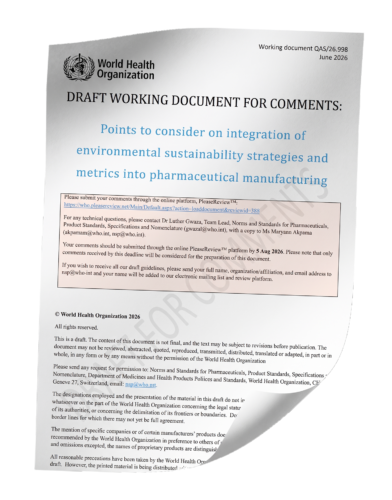
With the publication of the draft WHO/QAS26.998 – Points to Consider on Integration of Environmental Sustainability Strategies and Metrics into Pharmaceutical Manufacturing, the World Health Organization (WHO) signals an important direction: environmental strategies and metrics should become increasingly integrated into pharmaceutical manufacturing, the Pharmaceutical Quality System (PQS), and data-driven decision-making.
Within the WHO/QAS framework, QAS stands for Quality Assurance and Safety of Medicines. This is the technical area of the World Health Organization responsible for developing global standards, guidelines, and recommendations related to the quality, safety, and efficacy of pharmaceutical products. WHO also describes Good Manufacturing Practices (GMP) as part of quality assurance, ensuring that medicinal products are consistently produced and controlled according to standards appropriate for their intended use.
However, there is one aspect that many companies are still overlooking:
Paper-based validation is also part of the environmental problem.
Printed protocols, manual execution, physical attachments, handwritten signatures, scanning, paper archives, multiple review cycles, and documentation rework are still part of the daily routine in many Quality, Validation, Engineering, Operations, and IT departments.
If the pharmaceutical industry is serious about sustainability, the question should not only be:
"How can we reduce energy, water, solvents, and manufacturing waste?"
It should also ask:
"Why are we still validating processes, equipment, utilities, and computerized systems using slow, manual, paper-intensive methods?"
What Is the WHO Proposing?
The draft WHO/QAS26.998 proposes integrating environmental sustainability strategies and metrics into pharmaceutical manufacturing.
The document highlights indicators such as:
- Energy consumption
- Water consumption
- Solvent use and recovery
- Waste generation
- Emissions
- Carbon footprint
- Metrics such as PMI, E-Factor, and Scope 1, 2, and 3 emissions.
The WHO makes it clear that these initiatives should be implemented in a practical, risk-proportionate manner without compromising: Product quality; Patient safety; Data integrity; Traceability; Regulatory compliance; Continuity of supply
In other words, sustainability should not compete with quality. It should become an integral part of how the pharmaceutical industry measures, governs, and continuously improves its operations.
What Changes in Practice for Quality, IT, ESG, and Executive Leadership?
Historically, pharmaceutical companies have made decisions based on core pillars such as:
Product quality
Patient safety
Product efficacy
Regulatory compliance
Data integrity
Supply continuity
Environmental sustainability introduces an additional decision-making dimension.
This does not mean that the "greenest" alternative should always be selected.
Rather, it means that when two technical alternatives are equally robust, compliant, safe, and suitable, organizations should also consider their environmental impact.
A pharmaceutical company must choose between two validation approaches:
The first requires:
- Printed protocols
- Manual execution
- Physical circulation of documents
- Handwritten signatures
- Scanning
- Physical archiving
The second enables:
- Digital execution
- Electronic review
- Electronic signatures
- Audit trails
- Full traceability
- Real-time project management
If both approaches fully satisfy quality and compliance requirements, which one is more aligned with a modern sustainability strategy?
Increasingly, this question will no longer be merely operational.
It will become an executive governance, ESG, and strategic decision-making issue.
Paper-Based Validation: The Overlooked Sustainability Challenge
When sustainability is discussed within the pharmaceutical industry, the focus usually falls on:
Energy consumption
Water usage
Raw materials
Solvents
Emissions
Manufacturing waste
Paper-based documentation is rarely on that list — and it should be.
In many organizations, every validation project still involves:
Printed protocols
Physical attachments
Manual evidence collection
Face-to-face reviews
Paper signatures
Document scanning
Physical archiving
Documentation rework caused by version control issues
Limited project visibility
Significant administrative effort
This model consumes far more than paper: time, energy, physical storage, transportation, technical hours, management capacity. That's why digital validation is not just an operational efficiency initiative — it's a strategic decision aligned with environmental sustainability, data governance, and modernization of the Pharmaceutical Quality System.
Will sustainability become a validation criterion?
At this stage, the WHO draft does not appear to introduce a new regulatory criticality criterion specifically related to sustainability within validation.
The central message is different.
Sustainability should be considered as an additional dimension for decision-making, governance, and continuous improvement, without replacing the traditional principles of product quality, patient safety, data integrity, and regulatory compliance.
In practice, organizations will still need to demonstrate that their processes, equipment, utilities, and computerized systems are fit for their intended use.
However, they will also need to become capable of answering questions such as:
- How much paper is consumed in validation projects?
- How many documents are printed, signed, scanned, and physically archived?
- How much documentation rework results from manual processes?
- How many technical hours are spent on administrative activities?
- How much time is lost because validation status lacks visibility?
- Does the ESG department understand the environmental impact of validation processes?
- Can executive management justify digital validation as a sustainability initiative?
These questions change the conversation.
Instead, it becomes an ESG, operational excellence, and corporate strategy initiative.
Why Do Environmental Data Require Governance?
The WHO draft emphasizes the importance of measurable environmental metrics and documented, auditable, risk-based approaches. It also links sustainability to indicators, monitoring, documentation, data management, and continuous improvement.
This is particularly relevant for regulated organizations.
After all, environmental metrics only create value when the underlying data are trustworthy.
If a company claims reductions in resource consumption, improved efficiency, or lower environmental impact, it must be able to demonstrate:
Data origin
Traceability
Applied controls
Responsible individuals
Calculation methodology
Change history
Supporting evidence
Governance
This reasoning is already familiar to professionals working in validation, quality, and data integrity.
For this reason, there is a natural connection between sustainability, reliable data, and digital processes.
GO!FIVE® turns manual validation activities into digital, traceable, collaborative processes — for computerized systems, manufacturing processes, equipment, utilities, infrastructure, cleaning, and technology/automation projects.
Protocols, execution, evidence, reviews, approvals, e-signatures, audit trails and lifecycle management — in one traceable environment.
Reduces
- Printing & paper documents
- Documentation rework
- Approval time
- File fragmentation
- Dependence on manual controls
- Limited management visibility
Strengthens
- Traceability & standardization
- Governance
- Data integrity
- Collaboration
- Lifecycle control
- Evidence-based decisions
Manual Validation vs. Digital Validation
In a landscape where sustainability, data, and quality are becoming increasingly interconnected, digital validation becomes a strategic enabler.
| Manual Validation | Digital Validation with GO!FIVE® |
|---|---|
| Printed protocols | Digital protocols |
| Handwritten signatures | Electronic signatures |
| Scattered evidence | Organized, traceable evidence |
| Manual reviews | Collaborative workflows |
| Physical archives | Digital repository |
| Weak version control | Structured version control |
| Limited status visibility | Real-time project tracking |
| Documentation rework | Standardization and control |
| Slow approvals | Faster approval cycles |
| High administrative effort | Greater focus on critical analysis |
Digital validation does much more than reduce paper consumption.
It reduces effort, accelerates projects, strengthens governance, and improves an organization's ability to demonstrate compliance using reliable, traceable data.
The Impact of Digital Validation on Sustainability
Digital validation contributes to sustainability in two ways.
The first is direct:
- Reduced paper consumption
- Less printing
- Fewer physical archives
- Reduced document transportation
- Less documentation rework.

The second is strategic:
It accelerates the implementation of technologies that make pharmaceutical operations more efficient.
The more manufacturers invest in automation, computerized systems, monitoring technologies, analytics, digital twins, and artificial intelligence, the more validation projects they must perform.
The WHO draft itself recognizes digital technologies, monitoring, analytics, modeling, digital twins, and artificial intelligence as important contributors to sustainability.
If these projects continue to rely on manual validation methods, digital transformation will progress more slowly.
If they are validated digitally, organizations gain:
- Greater speed
- Improved traceability
- Higher operational efficiency.
In other words, digital validation does more than reduce the environmental impact of validation documentation.
It also accelerates the deployment of technologies that make pharmaceutical manufacturing more sustainable.
Key Terms Explained
| Key Term | Definition |
|---|---|
| PQS — Pharmaceutical Quality System | The Pharmaceutical Quality System (PQS) is the framework described in ICH Q10 for managing product quality throughout its lifecycle. It integrates quality management, risk management, continuous improvement, and management responsibilities. |
| SbD — Sustainability by Design | Sustainability by Design (SbD) means considering environmental sustainability from the earliest stages of designing processes, equipment, technologies, and operational decisions. |
| SSbD — Safe and Sustainable by Design | An approach that combines safety, sustainability, and performance from the design stage onward. |
| Scope 1, 2 and 3 |
These are categories defined by the GHG Protocol for classifying greenhouse gas emissions:
Scope 1: Direct emissions.
Scope 2: Indirect emissions associated with purchased energy.
Scope 3: Other indirect emissions throughout the value chain.
|
| PMI — Process Mass Intensity | A metric that measures the total amount of material required to manufacture a given quantity of product. |
| E-Factor | A metric that relates the amount of waste generated to the quantity of finished product produced. |
| Digital Validation | Digital validation is the execution and management of validation activities within a digital environment, including document control, evidence management, reviews, approvals, electronic signatures, traceability, and audit trails. |
Questions Pharmaceutical Companies Should Be Asking Now
If environmental sustainability is becoming part of the regulatory and strategic agenda for the pharmaceutical industry, organizations should begin asking themselves:
- Does our company still perform validation using paper-based processes?
- How much paper do our validation projects consume each year?
- How much time is spent printing, signing, scanning, and archiving documents?
- How many project delays occur because of poor visibility into validation status?
- Does our ESG team understand the environmental impact of regulatory documentation processes?
- Does our IT department recognize that digital validation can simultaneously support compliance and sustainability?
- Can our Quality department justify digital validation as a governance and operational efficiency initiative?
- Does executive management still view digital validation as a cost, or as a strategic enabler?
These questions reposition digital validation. It is no longer merely an operational tool.
Instead, it becomes an initiative that directly impacts:
Compliance
Productivity
Corporate governance
ESG
Digital maturity
FAQ – Validation and Sustainability
Instead, sustainability should be viewed as an additional dimension for decision-making, governance, and continuous improvement, while preserving the traditional pillars of product quality, patient safety, regulatory compliance, and data integrity.
Digital validation significantly reduces these impacts while improving traceability.
Digital validation contributes to environmental objectives by reducing paper consumption and operational resources.
It also strengthens the Governance pillar by improving control, traceability, data integrity, and management visibility.
If ESG seeks to reduce environmental impact while strengthening governance, digital validation represents a practical, measurable, and defensible initiative.
At the same time, it strengthens evidence management, audit trails, electronic signatures, traceability, and digital governance.
Although Computerized System Validation (CSV) and Computer Software Assurance (CSA) are important applications, digital validation also supports the validation of:
• Manufacturing processes
• Equipment
• Utilities
• Cleaning
• Infrastructure
• Technology projects
The objective is to transform traditionally manual documentation activities into efficient, traceable digital workflows.
Conclusion: Sustainability Also Requires Digital Validation
The WHO draft reinforces a clear direction:
Environmental sustainability is becoming an increasingly important component of operational maturity, data governance, and strategic decision-making within the pharmaceutical industry.
This does not mean abandoning the traditional pillars of quality.
Product quality, patient safety, product efficacy, data integrity, regulatory compliance, and continuity of supply remain fundamental priorities.
However, it does mean recognizing that sustainability must also be measured, governed, and embedded into organizational processes.
In this context, paper-based validation becomes increasingly difficult to justify.
Traditional Validation
Organizations that continue to rely on printed protocols, handwritten signatures, manual reviews, and physical archives maintain a validation model that is:
- Slower
- Less transparent
- More resource-intensive
- Less aligned with modern sustainability expectations
Digital Validation
Digital validation offers a practical opportunity to:
- Reduce environmental impact
- Increase operational efficiency
- Strengthen governance
- Accelerate regulated projects
GO!FIVE® supports Life Sciences organizations throughout this transformation by converting manual validation activities into digital, traceable, and more sustainable workflows.
Is your company still validating on paper?
If environmental sustainability is becoming part of the pharmaceutical industry's strategic agenda, digital validation should become part of yours as well.
References